Affichage des articles dont le libellé est Language / Langue. Afficher tous les articles

dimanche 20 mars 2016

Julie-Victoire Daubié: first French woman to have the Baccalauréat [Women's History Month]


On the great blog Plume d'Histoire, the author has written about the strong-minded woman who was Julie-Victoire Daubié, the first French woman who succesfully passed the Baccalauréat. I love how she brings to life the era and the mindset of her society.

A bit of History:

The Baccalauréat has been "reinvented" by Napoleon Ist in 1808, becoming a diploma allowing to start college education. Three Baccalauréats existed: Baccalauréat en Lettres (Letters), Baccalauréat en Sciences (Sciences examination) and Baccalauréat en Droit (Law). This last one was only for a few years.

When Napoléon published the decree, it was not mentionned that women were not allowed. Just people up 16 years of age. As the education of women in letters and sciences were very rare and no middle and high schools were available for them, they didn't have the idea to pass it. As Plume d'Histoire stats in her article, women during the majority of the 19th century were not considered as "humanly equals" to men. Working for 13 hours in a factory, that was acceptable, but learning astronomy, medecine, philosophy, etc, were way too difficult for them... (I'm so sarcastic here... grr)

Julie-Victoire Daubié's upbringing:

All that changed with a young woman raised in the Vosges, France. Julie-Victoire Daubié was born on March 26th 1824 and was the eighth child of a modest bourgeoise family. She lived in her paternal grand-father's house and was able to attend primary school -where she received her Brevet Elémentaire (Elementary Certificate).

With the help of her brother - a priest- who taught her Latin, Greek, history, geography and German, she succeeded at the Brevet d’aptitude à l’enseignement primaire supérieur (Certificate of capacity in the upper primary education), the only diploma accessible to women. She became a governess in France and later in Germany. She started to write a book "La femme pauvre au XIXe siècle" (the poor woman in the 19th century)... a book which will become a reality a few years later.

Making History:

When she wrote an essay on June the 15th of 1859 for the competition opened by the Académie impériale des sciences et belles lettres in Lyon, her life changed. The topic was inspired by François Arlès-Dufour, an industrial businessman:
Look for, especially on a moral point of view, (...) the most practical measures (...) to raise the salary of the women in equality as the men's one when there is equality of service or work; to open to women new career and to procure them jobs that replace those successively taken away by the concurrence of men and the transformation of uses or customs.
François Arlès-Dufour par Nadar
Médiathèque de l’Architecture et du Patrimoine
Her memoir "The poor woman by a poor woman" won the first prize. Arlès-Dufour became her protector. She decided then to register for the Baccaleuréat (legally nothing could prevent her to register) and was denied the registration by two Académies. The University of Lyon accepted and the 16th of August 1861 she passed her examination. The following day, she became the first bachelière es Lettres.

Legend of the delayed diploma...

Some said that the news of her success was not well received by everyone... What follows is seen as a "legend", but I couldn't leave it out of this post.

Her joy at being a Bachelière turned quickly to bitterness: the minister of Public Instruction, Gustave Rouland, refused to sign her diploma. As Julie-Victoire wanted to attend college for a Licence es Lettres, she needed her Baccalauréat!

François Arlès-Dufour spoke with the empress Eugénie who was a charitable woman and was moved by Julie-Victoire's plea. The same happened with her husband Napoléon III, a progressist and "equalitarian" man who forced Gustave Rouland to sign the diploma in March 1862. Nine month after she passed it, she had her diploma in her hands.

Some historians are dubtious of this story, because the delay between the examination and the diploma being received was between six to ten months during the Second Empire. Even if Julie-Victoire Daubié was not forced to plead with the Emperor, finally, an higher education was possible for the French women!

She was at that time a great example for many women, and even if only 10 women passed with flying colors the Baccalauréat in 1892, new secondary schools had opened for women. In 1920, they were more than one thousand.

Her career:

Julie-Victoire had a career as an entrepreneur (she bought an embroidery company), a journalist, a militant and a woman of letters. She had two goals: refute the inferiority of women and permit them to access to equal jobs and salaries.

Between 1866 and 1869, she published her work La femme pauvre du XIXe siècle (=,The poor woman of the 19th century), the fruit of vast researchs. The 28th October 1872 she also became the first woman Licencié es Lettres (without a "e" at the end, as the diploma title was only male at that time), and founded the "Association for the progressive emancipation of woman".

She had several correspondances with illustrious feminists and progressists men and women -Georges Sand, Alexandre Dumas Jr, Josephine Butler, Jules Simon, Léon Richet... She wanted for the French women to engage in economy, politics and vote, something that they were finally allowed to do only in 1944 (and they voted for the first time in 1945) !!!

Deadly sick with tuberculosis in 1874, she didn't have the time to finish her doctoral thesis "The woman condition in the Roman society". She left, at 50 years old, an imprint on the women of her time and others would further carry the hopes and vision of this discreet but persistent woman for more acknowledgement of women's rights.

Woman will become in the society whatever she will be able to be.   Julie-Victoire Daubié.

Fresque in honor of Julie-Victoire Daubié, in Fontenay-le-Chateau where she is buried.
Photo par Par E2 — Travail personnel, CC BY-SA 3.0


I passed my Baccalauréat Scientifique in June 2000 and I can't really grasp all the implications her will and her success had concerning the rights and socio-economic situation of women in France. Perhaps another woman would have tried a few years later than her? We don't know for sure... But what I know, is that, because of her, women received the opportunity to study and have better education. They weren't anymore these people that could not think and do something only men were able to...

She wasn't the only woman in the world who stood up for what was right and what women should be allowed to do, but for the French woman I am, the one who feverishly checked the lists of the results and shouted "YES" when I saw my name and my grade for the Baccalauréat examination, she's very important. So, thank you Julie-Victoire. All the French Bachelières should know your name and your story!


Women's History Month Series on Multicultural Kid Blogs

Join us for our second annual Women's History Month series, celebrating the contributions and accomplishments of women around the world. Follow along all month plus link up your own posts below! Don't miss our series from last year, and find even more posts on our Women's History board on Pinterest:


March 1
A Crafty Arab on Multicultural Kid Blogs: 7 Women Artists Who Changed History

March 3
The Art Curator for Kids: Songs We Can See - The Art of Peggy Lipschutz

March 4
Kid World Citizen: Children's Books about Women Scientists

March 7
Mama Smiles: Picture Books about Great Women in History Your Kids Need to Know

March 8
Hispanic Mama: 4 Latina Women Who Made It Happen

March 9
Discovering the World Through My Son's Eyes: Spanish Children's Book on the Life of Felisa Rincón de Gautier, First Female Mayor of San Juan, Puerto Rico

Colours of Us: 28 Multicultural Picture Books about Inspiring Women & Girls


March 10
Witty Hoots: Some Awesome Women in My Life

March 11
MommyMaestra: Women in World History Trading Card Template

March 14
Crafty Moms Share: The Thinking Girl's Treasury of Real Princesses

March 15
The Jenny Evolution: Non-Fiction Books about Women for Kids

March 16
Discovering the World Through My Son's Eyes

March 17
Living Ideas

March 18
La Cité des Vents

March 21
A Crafty Arab

March 22
La Cité des Vents

March 23
Peakle Pie

March 24
All Done Monkey

March 25
The Art Curator for Kids on Multicultural Kid Blogs

March 28
Creative World of Varya

March 29
Family in Finland

March 30
The Jenny Evolution

March 31
For The Love of Spanish


Creative Kids Culture Blog Hop

samedi 20 février 2016

Changing school: it can be hard but very helpful! [IMLD]


As I have hinted in my New Year's wishes and my absence from blogging, we had a few challenges in our family these past weeks. One of them was my son's schooling.

My son was so happy that day.
When we moved to Germany in September 2013, we had chosen to enroll our children in the German school system. Gabriel went to a German kindergarten as soon as we moved here and then had his "Einschulung" in our neighborhood school, and Sophie started in a kindergarten a week later, last September.


We thought that French at home and German at school would be great for them. Guess it was not to be. We knew that Gabriel could be a handful in class and were a tad worried about behavioral issues. In fact, his teacher told us he was loud and (too) energetic. Yeah, we know. We work on that at home too. However, she also told us to help him with his German vocabulary and I tried to repeat with him all the new words he encountered in his school books. The Logopädistin (ortophonist) he sees every week helps him too with vocabulary and how to pronounce some sounds (the sch, tch, ch, r, etc). This professional was optimistic and said he made real efforts.


Then, four days before the Christmas holidays came a letter from the school director. About the fact the children and the teachers had great difficulties to understand him. With his grammar, his vocabulary: in short, everything.

We were in shock. So was my son. He cried: "No one told me they couldn't understand me!" Huge meltdown during the week-end for him, and parental crisis for my husband and I.

In the letter, the director ordered us (because asked is not strong enough to translate how he phrased it) to bring our son after the holidays to a free helping class provided by the land of Hessen. 4 times a week, 45 minutes each time. That would have been a good help. If it wasn't in another school (it's easy with the U-bahn he said), during lunch time (yeah, cold sandwichs each time for the whole family), and with around 20 kids in a computer room playing educative games (we discovered that when we tried it)...

I went there once after the holidays, as ordered to do, with the two girls in tow, and if my son liked to play on a computer (no, really? huge surprise for me... tss), I was NOT thrilled to consider doing it four days in a row and know that my son will not learn much in such a big group without proper human interaction. If "everyone" couldn't understand him in German, how a computer would help him in the talking aspect? The ortophonist was also very sceptical because of my son's personality. Gabriel needs more a small group, or even better a one-on-one, approach to make him progress.

We could have forced him (and me) to go everyday to this "class", and start to speak to him in German, as "suggested" when we talked together, the director and I. We could have reduced his exposition to French and focused on him learning the "perfect German" they expected from him.


Sorry Mr Director, but NO. We love living in Germany, learning your language, discovering your culture, interacting with people... However, we are French and we are not going to forgo our culture, our language. You should have guessed, French people are known to be stubborned. Very so.

It's already difficult for a family to maintain what is seen as a "minority" or "family" language during the whole childhood and youth of the children, in a foreign country. We have many examples of people who didn't speak often their own languages (their mother tongue usually) to their children and have seen them lost contact with family members because of that. I have friends who told me how they have been rebucked by their in-laws to speak their own languages to their kids on the pretext of "you are in our country, so the children have to learn our language first"...


We did what we have the opportunity to do: we contacted the French school in Frankfurt to see if places were available for a mid-term schooling. And we asked my husband's job if they can help. It was not written in his contract that we could have a part of the kids' education payed... But we tried, and we explained my son's situation. During the holidays, he was sad, and when we talked about the French school (in fact a bilingual school) he was so happy and wanted to go there. We also prayed a lot, as did many friends and family members, to find guidance. I personaly felt relief, peace and the feeling that everything will turn for the better.

And it did. The day after my son tested the "free class", we received an answer from my husband's superiors. Our family was granted a kind of "educational fund", and now we have to pay only a part of the fees and of course, the lunch and transports. Then, the director of the French Primary school said to my husband that my son could start on the 1st of February in a CP (Cours Préparatoire = 1st Grade). We even found a nearby family who agreed with driving my son back from school.

My son turned 7 years old at the end of January and was able to have a Birthday party in his German class before transferring to his new bilingual school. I talked to his teacher on his last day and I really hope she understood that I have no ill feelings against her and that she didn't "failed" my son. She's a young teacher and these stressfull situation can damage confidence. My son liked her and he wishes to visit his "old class" during his holidays (not the same as the ones in the Hessen schools).


His start in the CP had been difficult. The French programm is more advanced than the German one on the topics of writing and reading. He hasn't the same level as the other kids in his class, but he is willing to learn and as long as he can do his beloved maths, he's happy. Well, he's struggling a bit but the teacher has lots of experiences with bilingual kids and 1st graders, so she has found a way to interest him and make him work on his writng and spelling skills. During the German class, he is in a group with a good German level. It doesn't seem that he is so "not understandable"... His French teacher has kindly given us a list of exercices we can do with him during these two weeks of holidays.

He will have to overcome a few issues to pass in CE1 next year, but -with my husband- we are more likely to be good helpers. French is our mother tongue, we are fluent in it and have a good grammar. For my son to be able to learn both his mother tongue and the majority language (German as we live in Germany), and in two years to start English, it's a great privilege, a huge blessing. We had planned differently, but the change is all for the better for my son.

On a more personal note, it's so strange for me to think that I'm in the "privilege group" now. I wasn't in my youth. So for my children to experience this multiculturality and this degree of both cultures, it's quite mind-blowing. I knew the moment we started to live in Germany that we had "more" than many of other Frenchs. Luckier in the job opportunity my husband had, more foreign knowledge and culture at my fingertips, a vision of the world more wider, more languages to speak on a daily basis, and so on.

But the Mother Tongue, the French part of our family which is so essential in our home, how were we going to live it? to pass it on the next generation? to treasure it? We tried to do it "alone" at home, but it was tough...

Lycée Français Victor Hugo (Frankfurt)

French expats are some of the most blessed people out there: with the net of French schools around the world, many of us are able to provide for our children both our French culture and the one from the country we live in. And when the parents are a mix-couple (ex: a French dad and a German mom), the two cultures can be taught to the children and both sides of the family are happy...

I'm quite proud of these schools and this network. I so wish for other countries to be able to provide such high standards of education to their own expatriated populations. I think about my polish, spanish or danish friends. They can find playgroups but rarely bilingual schools... or they are expensive (more than the French schools). Accessing the culture of our home country, our mother tongue, this is essential in the preservation of our identity and the understanding of who we are and who we can be.

Learning in our mother language shouldn't be a privilege. It should be possible along classes in the majority language(s) of the country you live in. That's why the programm of UNESCO and the International Mother Language Day are so important! 

mardi 12 janvier 2016

"Crocolou aime..." : un mi-loup / mi-crocodile que les petits adorent!

Ma fille Sophie a son personnage de livre préféré: Crocolou. Sa maman est une crocodile et son papa est un loup. Lui et sa petite soeur Marilou sont donc un mélange des deux: mi-crocodile et mi-loup.


Bien que les histoires des 30 albums ne se focalisent pas forcement sur la composition de cette famille, il est intéressant de noter que l'auteur a voulu représenter une famille bi-raciale dans le contexte du quotidien d'un enfant de 4 ans. Et ça, c'est une excellente initiative! Les lecteurs apprennent à aimer ce personnage qui a des parents différents l'un de l'autre, une façon simple d'enseigner le respect et la tolérance. Surtout que Crocolou a beaucoup d'amis qui ne pointent pas du doigt le fait qu'il soit un mélange de loup et de crocodile. Le personnage lui-même a des caractéristiques de ses deux parents: il dit par exemple qu'il a "une faim de loup" et aussi qu'il adore aller dans l'eau (côté crocodile). C'est un garçon bien dans sa peau.

L'auteur est Ophélie Texier et depuis 15 ans elle illustre des livres pour les tous-petits. Crocolou est sa première création "texte et illustrations". On lui dit un grand merci pour son travail!

Nous avons actuellement six livres de la collection Crocolou à la maison. Celui que j'aime tout particulièrement, c'est Crocolou aime les voyages. Ma fille a pris l'avion pour la première fois l'année dernière, et ce livre a été acheté peu de temps après. Elle était toute heureuse de pouvoir faire le parallèle entre son expérience et celle de Crocolou. Bon, nous étions chez les grands-parents à Toulouse, pas dans un pays lointain et "exotique" comme le pays des Souris décrit dans le livre. Un pays où il fait chaud, où il y a la mer et des champs colorés.


Toutefois, et grâce à ce livre, ma fille veut maintenant voyager là-bas (ou un vrai pays qui s'en rapproche...) et expérimenter la plage, la plongée, se faire des amis et découvrir d'autres nourritures... Bon, question nourriture, la page en question lui fait un peu peur (certaines bestioles) mais comme Crocolou a décidé de goûter à ce qu'il ne connait pas, elle le trouve très courageux. Ce qui est drôle, c'est que le dessin montre plus ce que les enfants imaginent comme nourriture étrangère et "bizarre" que ce qu'on mange vraiment dans d'autres cultures. Ok, dans certaines régions on mange des grillons et des sauterelles et autres "choses", mais c'est quand même assez atypique.


Les autres titres que nous avons acheté (ou que les grands-parents ont offert) correspondent à des thèmes liés à nos enfants. Crocolou aime les gâteaux est le préféré de Sophie. On se demande bien pourquoi... C'est une gourmande notre fille! Qui a beaucoup de mal à manger des légumes! Alors quand Crocolou demande à ses parents des gâteaux, des bonbons ou de la glace plutôt que sa soupe et ses épinards, ma fille comprend tout à fait le personnage. Heureusement, Crocolou finit par accepter de manger son repas, qu'il trouve en fait délicieux, et a droit aussi à un dessert! A force de lui lire ce livre, j'espérais que ma fille accepte de manger un peu plus du plat principal, mais bon, ce n'est pas encore gagné.

Crocolou aime son doudou est le premier que nous avons eu et a les faveurs de ma fille et de son grand-frère. Crocolou aime son papi et sa mamie également. Par contre Crocolou aime la cantine fait demander à mon fils le droit de retourner y manger (c'était le cas au Kindergarten mais plus maintenant qu'il est en Grundschule) et ma fille veut rester avec ses copines le midi, comme Crocolou. Enfin, Crocolou aime les livres met tout le monde d'accord et les deux sont très fiers d'avoir eu dès leurs 18 mois une vraie bibliothèque dans leur chambre (bien avant le personnage de Crocolou!)


Crocolou est une collection adaptée pour les petits et les lecteurs débutants. Chaque titre explore un thème de l'enfance. J'apprécie le fait que les titres des livres commencent tous par Crocolou aime... ce qui focalise la narration sur des aspects positifs et aident les enfants à surmonter une difficultés quand bien même ce n'est pas ce qu'ils préfèrent. Par exemple dans Crocolou aime les gâteaux: il les aime, mais cela ne l'empêche pas de se rendre compte que les autres aliments sont aussi bons. Ou bien dans Crocolou aime son doudou où il le perd dans la journée et finit par se rendre compte qu'il l'a en fait oublié en jouant dans le jardin, d'où l'idée sous-jacente de faire plus attention aux choses que l'on aime.

Le site de l'éditeur a dédié tout un espace pour la collection Crocolou, avec des jeux éducatifs, une chanson et même des fiches pédagogiques pour les enseignants des écoles maternelles.


Creative Kids Culture Blog Hop

mercredi 19 août 2015

To motivate a multilingual child in using more one of his languages [MKB 2015 Vlogging Phone]

This Summer, I have accepted to be one of the Multicultural Kid Blogs members taking part in the yearly Vlogging Phone*. This year topic is Raising Multilingual Kids.


The question I will answer in my video is from Annabelle who writes at The Piri-Piri Lexicon:

What to do when the need for your child to speak one of their language is very small? How do you motivate them? How can you make up for it?


As you can see, my only option to record this video in a timely fashion was to carry my two weeks old daughter... So, sorry if you don't see my face as much as you would have liked. I did it in one take, and as she was starting to fuss when I watched it a first time, I was a bit "scared" to try another recording session...  

My question goes to Michelle, who writes in the blog MothertonguesHow do you teach multicultural awereness and appreciation to your kids?


* : What is a Vlogging Phone? Well, it's rather simple: one blogger ask a question to another blogger who will answer in a video on her/his own blog. Then she/he will ask another question to a third blogger and so on. The last on the list will ask the first one.


vendredi 31 juillet 2015

Livres / Books: Les 3 jeunes détectives / The 3 Investigators

Créée aux Etats-Unis par Robert Arthur, la série de romans pour adolescents The 3 Investigators (traduite en français par Les 3 jeunes Détectives) compte 43 tomes. 11 furent ajoutés dès 1989, lorsque la série fut réorganisée. Au début, le nom de la série était "Alfred Hitchcock and the 3 Investigators" mais à la mort du réalisateur, il fut changé.
J'avais lu quelqu'uns des livres de cette série étant jeune car j'adore les romans policiers, et mon mari en avait également lu. En furetant parmi les caisses de livres d'occasion à Paris, j'ai trouvé un des romans: le Serpent qui fredonnait (publié en 1972, et traduit en français en 1977). 
En recherchant sur internet comment cette série s'appelait en allemand, j'ai eu la surprise de découvrir qu'elle était extrêmement populaire, bien plus encore qu'aux Etats-Unis! Die 3 ??? (lisez: Die Drei Fragenzeichen) comprend la série originale ainsi que des romans supplémentaires écrits par des auteurs allemands depuis 1993. Au total en mai 2014, 179 livres sont compris dans cette série en version allemande! Avec de plus 168 adaptations audio, qui sont bien plus connues et achetées que les livres! Malheureusement pour les lecteurs francophones, il n'y a encore aucune traduction des tomes allemands en français... Mon mari a beau faire la tête, mon fils veut déjà que je lui lise - en allemand - ces romans. Oui, lui aussi adore les romans policiers et les mystères!

Created in the USA by Robert Arthur, this series of romans for teenagers The 3 Investigators has originally 43 books. 11 were added when the series was revamped in 1989. At the beginning, it was called "Alfred Hitchcock and the 3 Investigators" but after the director's death it has been changed.
I had read a few books during my youth, as did my husband too. While rummaging in a box of second hand books in Paris, I found one of them: The Mystery of the Singing Serpent (published in 1972).
When I looked on the internet how this series was called in German, I was surprized to discover that it was very popular, more than in the USA! Die 3 ??? (read it: Die Drei Fragenzeichen) include both the original series, the revamp edition and stories written by German authors since 1993. The total of books is 179 in May 2014 in the German version! With also 168 radio dramas, which are even more famous and bought than the books! Sadly for the English readers, just a few of the German books have been translated... My husband may make a face, but my son already wants for me to read him the German books. Yes, he loves detective and mystery novels like his mum!


Disponibles dans toutes les librairies (s'ils n'en ont plus, ils peuvent les commander facilement). Allez jeter un oeil aussi sur les deux films réalisés par les Allemands: Le Secret de l'île aux fantômes, et Le Manoir de la Terreur. On a passé un bon moment avec mon fils, vautrés sur le canapé, à les regarder (merci la bibliothèque municipale!)
Available in all the bookshops (if they don't have them anymore, they can order them easily). Don't forget to watch the two German movies : The Secret of Skeleton Island, and The Secret of Terror Castle. We had a good time my son and I, sprawled on the sofa, watching them (thanks to the local library!)


To see what the other bloggers have chosen for this Summer Reading Series, 
will have all the links!

Don't forget also to check the Pinterest board.

mercredi 22 juillet 2015

Livre / Book: La Galette du Roi Soleil


I'm so happy to present this book I have discovered in my childhood for the MKB Read Around the World Summer Reading Series! Some books we read as a child will "follow" us our whole life. This is one of those, for me. 
Je suis très heureuse de présenter ce livre, que j'ai découvert dans mon enfance, pour la série de lecture d'été "Read Around the World" de MKB! Certains livres que nous lisons lorsque nous sommes enfants nous "poursuivent" notre vie entière. Celui-ci, pour moi, en fait partie.

La Galette du Roi Soleil (the Sun King's Galette), by Daniel Hénard, is a short roman I read during my 4th grade (if I remember correctly).I loved it back then for his setting (17th century France, the "château de Versailles", etc) and for the vocabulary used. The author has tried his best to write his story with the words of that time. For a young French learning his mother language, it's really a challenge to understand all the new (hum, hum... ancient) words! And my teacher knew it, that's why he made us study it...
La Galette du Roi Soleil, par Daniel Hénard est un roman court que j'ai lu en CM1 si mes souvenirs sont exacts. Je l'aimais à l'époque pour son "décor" (la France du XVIIe siècle, le château de Versailles, etc) et pour le vocabulaire utilisé. L'auteur s'est appliqué à écrire son histoire avec du vocabulaire de l'époque. pour une jeune française apprenant les rouages de sa langue maternelle, c'est une épreuve de comprendre tous ces nouveaux (hum, pardon, "anciens") mots! Et mon professeur le savait fort bien, c'est pourquoi il nous l'a fait étudier...

But don't be afraid: the story in itself is not too long and many of the old words are explained at the bottom of each page, or in the "Documents" at the end of the book. Because after the story, the reader has questions / exercices for each chapter and several pages of documentation.
Mais ne soyez pas effrayé: l'histoire en elle-même n'est pas trop longue et une grande partie des mots "désuets" sont expliqués dans les notes de bas de page, ou bien dans les Cahiers documentaires à la fin du livre. Parce qu'après l'histoire, le lecteur peut répondre à des questions / des exercices pour chaque chapitre et lire plusieurs pages de documentation.

The daily life of the "Sun King", Louis XIV, is detailed. It's perfect to learn more about History and French culture.
La vie quotidienne du Roi Soleil, Louis XIV, est détaillée. C'est une belle opportunité d'apprendre un peu plus l'histoire et la culture française.

Informations about the clothes worn by the French nobles or how to become a Master (in Pâtisserie, or other trades) can also be found.
Des informations sur les habits portés par les nobles de France ou bien comment devenir un Maître (pâtissier ou autre corporation) peuvent aussi être trouvées.

Example of exercices. My son is still too young to do them, but I read them aloud and answered them. He liked to "help me" figure the solutions...
Exemple d'exercices. Mon fils est encore trop jeune pour les faire seul, mais je les ai lu à haute voix et il a essayé d'y répondre. Enfin, il a surtout aimé "m'aider" à trouver les solutions...
Pictures highlight the life Jean is living as a Pastry cook. Picture above: the procession for the King's Lunch, from the Kitchen of the Grand Commun (building where the kitchens are) to the King's chambers.
Les dessins illustrent la vie de Jean en tant que pâtissier. L'image ci-dessus représente la procession du repas du Roi, depuis les cuisines royales situées dans le bâtiment du Grand Commun jusqu'aux appartements du Roi, dans le château.

I don't want to spoil you the story too much. Just let me say that the main character, Jean (please, prounonce it the French way...), is an orphan who loves to bake and is really talented at it. He will encounter people who will help him progress in his art and some who are not so well-disposed with him. You will learn that French Pastry in the old days was not only about sweet tastes with chocolate, fruits and creams, but also about pâté en croûte, vol-au-vents and terrines. And you will have a glimpse in the life of the inhabitants of the Château de Versailles right after its construction.
Je ne veux pas vous dévoiler trop l'intrigue. Laissez-moi juste vous dire que le personnage principal s'appelle Jean, qu'il est orphelin et qu'il se découvre une passion pour la pâtisserie pour laquelle il excelle. Il va rencontrer des personnes qui l'aideront à progresser dans son art et d'autres qui seront beaucoup moins bien disposés envers lui. Vous apprendrez que la Pâtisserie française à cette époque n'était pas seulement à propos de mets sucrés délicieux avec chocolat, fruits et crèmes, mais également de pâtés en croûte, de vol-au-vents et de terrines. Vous aurez aussi un coup d'oeil dans la vie des habitants du château de Versailles juste après sa construction.

For children above 8 years old learning French, be it their mother tongue or a second / third language, this book should be a good introduction into French 17th century History, Gastronomy and old vocabulary.
Pour des enfants à partir de 8 ans apprenant le Français, que ce soit leur langue maternelle ou bien en seconde / troisième langue, ce livre peut être une bonne introduction à l'histoire française au XVIIe siècle, sa gastronomie et son langage.


To see what the other bloggers have chosen for this Summer Reading Series, the main page on the MKB blog will have all the links!
Don't forget also to check the Pinterest board.

mardi 16 juin 2015

P est pour Parc de Jeux / P is for Playground / P ist für (Spiel)Platz [A - Z of Raising Global Citizen]


Bonjour à toutes et à tous!
Hello everybody!
Hallo Leute!

Lorsque Varya de Creative World of Varya a partagé son idée avec les blogueurs de la communauté Multicultural Kid Blogs de créer un Abécédaire sur le thème Elever des Citoyens du Monde, un grand nombre d'entre nous était ravi de ce projet! Ce fut une course folle vers le document de planification pour choisir notre lettre et le mot que nous allions y associer. J'étais tellement heureuse quand j'ai vu que la lettre P n'était pas encore réservée! Je voulais depuis un certain temps refaire un jeu de cartes trilingues à propos des Parcs de jeux et c'était l'opportunité qui me stimulerait pour le finir.

Et puis... c'est aussi parce que les aires de jeux sont des endroits excellents pour que les enfants puissent apprendre, jouer, découvrir de nouvelles choses. Et pour être de meilleurs Citoyens du Monde!


When Varya from Creative world of Varya shared with the bloggers of the Multicultural Kid Blogs community her idea of creating an A - Z of Raising Global Citizen, many of us were thrilled with the project! It was quite a mad dash to the planning doc to chose our letter and the word we will associate with it. I was overjoyed when I saw that the letter P was still not taken! I had wanted for quite some time to do another set of trilingual cards about "Playground" and it was the perfect opportunity to boost me to finish it.

And well... it's also because Playgrounds are a great place for children to learn, play, discover new things. And to be better Global Citizen!


Als Varya von Creative World of Varya geteilt mit dem bloggers der Multicultural Kid Blogs Gemeinshaft ihre Idee davon, A - Z Erhebens Globalen Bürgers, viele von uns zu schaffen, mit dem Projekt erschauern lassen wurde! Das war ganz ein verrückter Sprung zum planenden Dok dazu wählte unseren Buchstaben und das Wort, das wir damit vereinigen werden. Ich war überglücklich, als ich sah, dass das Buchstaben P noch immer nicht genommen wurde! Ich hatte eine Zeitlang einen anderen Satz von dreisprachigen Karten über "Spielplatz" tun wollen, und es war die vollkommene Gelegenheit, mich hochzutreiben, um es zu beenden.

Und gut ... ist es auch, weil Spielplätze ein großer Platz für Kinder zu lernen, spielen, entdecken neue Sachen sind. Und besserer Globaler Bürger zu sein!


Parc (ou Aire) de jeux / Playground / Spielplatz:

Pourquoi un Parc de jeux est-il un lieu significatif pour sensibiliser nos enfants à être un Citoyen du Monde? Et pourquoi je les aime?

Aller au parc avec ses enfants est un "rite de passage" pour la plupart des parents. Là, les petits apprennent comment mobiliser leur corps pour effectuer diverses actions: sauter, grimper, glisser, se balancer, marcher en équilibre... La motricité se développe en copiant: les plus jeunes aiment prendre exemple sur les plus grands et on imite maman ou papa qui marche sur le tronc d'arbre renversé, ou grimpe des escaliers.

Le deuxième bénéfice d'une sortie au parc est la socialisation. Les enfants doivent laisser les autres jouer sans leur "piquer" leurs jeux. Ils doivent également savoir être patients (la balançoire ne peut pas être occupée par quatre enfants en même temps, par exemple), faire preuve de mesure dans leurs gestes (quand on joue à "chat", attention de ne pas pousser les autres, etc) et respecter les règles en vigueur dans le parc (exemple: pas de vélo, pas de ballons, trier les déchets, etc). Mais ils ont surtout la chance de pouvoir rencontrer des enfants d'horizons diverses. En effet, les parcs de jeux auxquels on va ne sont pas toujours ceux de notre quartier. Les enfants qui y seront présents ne sont pas forcément les mêmes que ceux de l'école où nos enfants sont scolarisés.

Parmi les enfants rencontrés dans les aires de jeux, certains peuvent avoir des origines ethniques fort différentes des vôtres. Lorsque vos enfants sont encore tous-petits, ils pourront avoir des questions "pourquoi ses cheveux sont bouclés?" ou "qu'est-ce qu'il a sur le visage?" (des tâches de rousseur), "pourquoi il parle comme ça?" (langue différente), "il a une couleur de peau différente?", etc. C'est un bon moment pour expliquer qu'il y a dans le monde des gens ayant des traits physiques différents des nôtres, que ce n'est pas quelque chose de "mal" ou qu'il faille en rire. Pour eux, nous sommes aussi différents à l'extérieur. Et que ces enfants, tout comme les nôtres, ont envie de jouer à la balançoire, à cache-cache... Les enfants comprennent vite que ce sont des camarades de jeux, point barre. Et une langue étrangère est rarement un véritable frein à leur désir de jouer ensemble.

Si vous êtes en visite dans une autre ville, faites un détour dans un parc de jeux: vos enfants découvriront de nouvelles installations, et pourront jouer avec de nouveaux "copains" (au bout de 15 min, ils sont déjà copains...) Et si en plus vous êtes dans un autre pays, alors là, c'est encore mieux! Ils se souviendront d'autant plus de cette pause ludique qu'elle sera dans un environnement inédit!


Why would a Playground be a meaningful place to raise awareness in our children about Global Citizenship? And why do I love those?


Going to the playground with the children is a "rite of passage" for most parents. There, the kids learn how to mobilize their body to do various actions: jump, climb, slide, rock, walk with balance... Motricity will be developped while copying: the youngests love to do the same as the older kids, or they imitate mum and dad who are walking on a fallen tree trunk or climbing a staircase.

The second benefit from a time at the playground is socialization. Children have to let the others play without stealing their toys. They have also to learn Patience (the swing can't be used by four children at the same time, for example), show measure in their movements (when they play "catch", be careful not to push the others, etc) and respect the playground rules (ex: no bicycles, no balls, sort the trashs, etc). But they have above all the chance to meet children from diverse backgrounds. In fact, playgrounds we like to go to are not always the one from our neighborhood. Children there are not always the same from our children's school.

Among the children you will encounter on playgrounds, some can be from ethnic origines very different from yours. When your children are toddlers, they will certainly have questions like "why does she have curly hairs?", or "what does he have on his face?" (freckles), "why do they speak like that?" (foreign language), "why does his skin color is lighter/darker than mine?", etc. It's a perfect moment to explain them that in this world, people come in various shapes, sizes and skin colors, that it's not something either "bad" or "laughable". For these children, we are also very different outside. And they want, like our kids, to play on the swing, or go "hide and seek"... The kids understand quickly that they are new "playdates", point. And a foreign language is rarely a brake to their desire of playing together.

If you are visiting another city, make a detour in a playground: your children will discover new contraptions, and they will be able to play with "new friends" (after 15 minutes, they are already friends...) And if you are in another country, lucky you, it's even better! They will remember better this playful break seeing as it's in a new environnement!


Warum würde ein Spielplatz ein bedeutungsvoller Platz sein, Bewußtsein in unseren Kindern über Globale Staatsangehörigkeit zu erheben? Und warum liebe ich jene?

Gehen zum Park mit den Kindern ist ein "Ritus der Passage" für die meisten Eltern. Dort lernen die Kinder, wie man ihren Körper mobilisiert, um verschiedenartige Tätigkeiten zu tun: Sprung, Aufstieg, Gleiten, Felsen, mit Gleichgewicht spazieren...  Sie lernen bei kopieren: die Jüngsten lieben, um denselben als die älteren Kinder zu tun, oder imitieren sie Mama und Vati, die auf einem gefallenen Baum-Stamm spazierengehen oder Treppen ersteigen.

Der zweite Gewinn eines Ausfuhr im Park ist die Sozialisierung. Kinder müssen die anderen spielen lassen, ohne ihr Spielzeug zu stehlen. Sie sollen ebenfalls geduldig sein können (die Schaukel kann von vier Kindern gleichzeitig nicht besetzt sein, zum Beispiel), achten wann spielen (nicht die anderen Kindern schieben, etc), und die gültigen Regeln im Park achten (Beispiel: kein Fahrrad, kein Ballons, sortieren die Abfälle, u.s.w.). Aber sie haben vor allem Chance, Kinder von Horizonten unterschiedlich treffen zu können. Wirklich sind die Spielplatz, in die man geht, noch diejenigen unseres Bezirkes(Vierteljahres) nicht. Die Kinder, die dabei anwesend sein werden, sind dieselben nicht notgedrungen, daß diejenigen der Schule, wo unsere Kinder beschult sind.

Unter den Kindern, die an der Spielplatz getroffen sind, können manche sehr unterschiedliche ethnische Ursprünge der eueren haben. Als ihre Kinder noch alle Kleinen sind, werden sie Fragen haben können: "Warum hat sie Lockenhaare?", oder "Was hat er an seinen Gesicht?" (Sommerprossen), "Warum sprechen sie komisch?" (andere Sprache), "Warum hat er eine unterschieldliche Hautfarbe?", etc. Eben einen guten Moment, um zu erklären, gibt es in den Welt der Leute, die unterschiedliche körperliche Charakterzüge der unseren hat, daß man eben etwas des "Übels" oder darüber lachen muß. Für sie sind wir draußen auch unterschiedlich. Und was haben diese Kinder, ganz wie die unseren, Lust, die Schaukel, das Versteckspiel zu spielen... Die Kinder verstehen schnell, daß sie Kameraden sind, und es ist alles. Und eine Fremdsprache besteht selten eine echte Bremse in ihrem Wunsch darin, zusammen zu spielen.

Wenn Sie im Besuch in einer anderen Stadt sind, einen Umweg in einer Spielplatz machen: ihre Kinder werden neue Einrichtungen entdecken, und werden mit neuen "Kameraden" spielen können (ab 15 Minuten sind sie schon "Kameraden"). Und wenn Sie dazu im anderen Land, dann da sind, ist das noch besser! Sie werden sich an diese Spielpause um so mehr erinnern, als sie in einer unveröffentlichten Umwelt sein wird!


Ces jeux ont été photographiés à Perpignan (ligne du haut et du bas), Castres (milieu gauche), et à Muret (milieu droite).
Playgrounds from France: Perpignan, Castres and Muret.
Speilplätze in Frankreich: Perpignan, Castres, Muret.

Voyons ce que nous pouvons trouver le plus communément dans une aire de jeux (à part les bancs, tables de pique-nique, poubelles, arbres et buissons fleuris...) Les photos suivantes viennent de parcs allemands (surtout Oberursel).

Let see what we can find the most commonly on a playground (beside the benchs, the picnic tables, the trash can, the trees and the flower bushes...) The following pictures have been taken in German playgrounds (mostly Oberursel).

Lassen Sie sehen das, was wir meistens auf einem Spielplatz (außerhalb der Bänke, der Picknick-Tische, des Mülleimers, der Bäume und der Blume-Büsche ...) finden können. Die Bilder waren in deutschen Spielplätze genommen (meisten Oberursel).


Balançoire / Swing / Schaukel


L'une des activités préférées de mes enfants, surtout de ma fille. Assise, debout, à califourchon, elle ne s'arrêterait pas et me demanderait de la pousser toujours plus haut. Histoire d'attraper les feuilles dans les arbres.
Les balançoires peuvent être en plastique, en bois, en métal, en pneus, avec hamac, pour bébé, pour adultes (oui, ça existe), à plusieurs, tenues par des cordes ou par des chaînes... Mais peu importe la forme, le plaisir est toujours au rendez-vous!

One of the favorite activity for my children, especially my daughter. Seated, standing up, astride, she would never want to stop and would ask me to push higher and higher. Just so that she can touch the leaves on the trees. 
The swings can be made in wood, plastic, metal, with tyres, like a hamac, for babies, for grownups (yes, it exists), for several people, hold by ropes or by chains... But whatever the shape, the fun is always there!

Eine der lieblingsten Aktivitäten meiner Kindern, vor allem meine Tochter. Stehend, rittlings, gesetzt, hörte sie nicht auf und bäte mich darum, sie noch höher zu schieben. Um die Blätter in den Bäumen zu fangen. 
Die Schaukeln können aus Plastik, aus Holz, aus Metall, aus den Reifen, mit Hängematte, für Baby, für Erwachsene sein (ja, das existiert), für mehrere Menschen, was von Seilen oder von Ketten gehalten sind... Aber nicht so wichtig ist die Form, das Vergnügen immer für die Verabredung!


Toboggan / Slide / Rutschbahn


Pour descendre... ou pour monter (même si ce n'est pas fait pour cela).

To go down... or go up (even if it's not made for that).

Um hinunterzugehen oder um zu steigen (selbst wenn das dafür nicht gemacht ist).


Les cabanes en bois / The wooden hut / die Holzhütten


Elles sont idéales pour y faire la dînette avec du sable, se cacher, discuter, grimper sur le toit, etc.

They are ideal to prepare meal from sand, to hide, to talk with a friend, to climb on the roof, etc.

Sie sind ideale mit den Sand ein Essen zu vorbereiten, sich zu verstecken, diskutieren, an das Dach klettern, etc.

L'échelle de corde / the rope ladder / die Strickleiter


Aller plus haut, ressentir le frisson du danger, et rester bloqué(e). Je pense que c'est un bon résumé...

Going higher, feeling the thrill of danger, and staying frozen at the top. I think it's a good summary...

Höher gehen, den Schauder der Gefahr spüren, und steckengeblieben bleiben. Ich denke, daß das eine gute Zusammenfassung ist...

*****

Je sais que de nombreux blogueurs ont écrit des articles sur les parcs de jeux, un peu partout dans le monde. Participez au Link-Up ouvert du 15 juin au 3 juillet et partagez vos articles ayant pour thèmes les parcs de jeux! Photos, informations, différences culturelles, histoires rigolotes ou bien éducatives, tout est bienvenu!

I know that many bloggers have written about Playgrounds, around the world. So take part in this Link-Up open from June 15th to July 3rd, and share all your posts about playgrounds! Pictures, informative posts, cultural differencies, funny stories or more educative ones, all are welcomed!

Ich weisse, dass vielen Bloggers Artikeln über Spielplätze im unser Welt geschrieben haben. Nehmen Sie an dieser Verbindung (Link-Up) offen vom 15. Juni bis zum 3. Juli teil, und teilen Sie alle Ihre Posten über Spielplätze! Bilder, infos, kultural Unterschiede, lustigen Geschichten, oder erzieherische Geschichten, alle sind willkommen!


Global mini
In these Series 24 bloggers of Multicultural Kid Blogs Community got together to share ideas and tips on Raising Global Citizens. Follow us from June 1st to June 26th as we share a letter of the alphabet and an idea associated with it over at Raising Global Citizen Series page!
Creative World of Varya = Bilingual Avenue The European Mama = Melibelle in Smart Tinker = Good To Be Mom = Marie's Pastiche = Third Culture Mama = Tiny Tapping Toes = All Done Monkey = Russian Step By Step = Multilingual Parenting = In The Playroom = Rue Du Belvedere = Discovering the World Through My Son's Eyes = La Cité des Vents = Faith Seeker Kids = World Languages = The Piri-Piri Lexicon = Healthy Child, Global Mind = Mama Smiles = The Art Curator for Kids Words n Needles = Multicultural Kitchen = Crazy Little Family Adventures

vendredi 20 février 2015

The Importance of the Mother Language... told in different languages.

Tomorrow will be International Mother Language Day, an event created in 1999 by the UNESCO and held for the first time on the 21st February 2000. Today a conference is held at UNESCO headquarters. On their website, you can find many informations about their programs to developp education in the local languages and preserve the culture of the people where they live.

I'm quite proud, and at the same time a bit nervous, to be the last one of our group of bloggers who have promoted this event these last 30 days... The topic for today's blog post is "the Importance of Mother Language", and as I live in a city where many different nationalities and ethnies live (Oberursel, near Frankfurt, Germany), I had the idea of asking people (neighbors, friends and fellow bloggers) what they think about their Mother Language.
I asked them two questions: "Why do you love your Mother Language? What is so important for you about it?" As I was a bit busy, I didn't have time to record some people I know speaking Macedonian, Farsi, Turkish, Lingala, Hungarish, Croatian, Japanese and so on... 

Of course, you dear readers, you can also participate! In the comment section at the end of the post, you can share your thoughts!

***

As I have started to receive the answers, I recognize a patern in them. They all speak about their family and the bond their language has with their heart. What links us to the languages we speak since birth/childhood, is something more profound than just a knowledge, a set up of the mind. It comes from the deepest part of who we are, our "core". This article in the Fountain Magazine, issue of July/August 2010: Mother Tongue: the language of Heart and Mind explains it fairly well.

As a French, having learnt French from birth, I can't phantom a day when I wouldn't be able to express myself in French. Of course, I love to speak / read / write in English (like right now) and I have developped a strong bond to this language, but French (and the culture attached to it) is a part of me so intricatly wooven in my spirit, my soul and my body, that I can't reject it or forget it. All the other languages I'm learning or I will learn, they will add facets to my personnality and my knowledge, but they won't change who I am.


Sometimes, languages ARE LOST... Not only because people stop using them, but also because the population speaking it "died out". The Map of Native American Tribes in their own languages Mr Aaron Carapella is putting together is both a ressource and a reminder that many Native American cultures have disappear. Civilizations can end, but what is worse is that no one remember them or systematicly and willingly "forget" them from historical records.

In a world were communication is "easier" on a wide scale, and a handful of languages is intensively used in this globalization, I am not the only one who wishes for a more multicultural life: multilingualism, understanding of other cultures, preservation of the patrimoine, etc. 

With the insights given by the following men and women, may we see the beauty of the human diversity. May we protect and speak, write, share our mother language(s), as much as all the other languages we have learned along our life journey.


The "Russian soul" was quite receptive at my plea, and I have three russian speakers who have shared their love of their language. It seems to me that those speaking Russian since birth enjoy their languages very much, and are proud of the culture around it.
Anna blogs at russianstepbystepchildren.com
Raising a trilingual child
Galina has started an initiative to help families to find a playdate in their mother tongue
 (here the website). 
 creativeworldofvarya.com

For English speaker since birth, it is both a great gift and a disavantage. When I talk to friends coming from USA or UK, they explain me their struggle. They know how English is "talking over the world", and it makes life easy for them when they have to move overseas. However, the lack of enthusiasm for learning a new culture (language and way of life of other nations) in their youth (and it stills goes on for the teenagers nowadays) has handicaped them for social interactions.

Of course, all English speakers are not monolingual!  I know an educated and amazing woman who speaks English, French, Norwegian, German, and Italian. And she's not keen on stopping learning about the world and its diversity. 

Just thinking about my friends who came from English speaking countries in Africa as first generation migrants or second ones... They have learned in their childhood both English and the local language or dialect. And now, they have added one or two more! However, some tend to struggle to keep their African language alive and pass it on their children. The same can be said for Asiastisch and "Tribal languages" of South America...


lingolised.eu


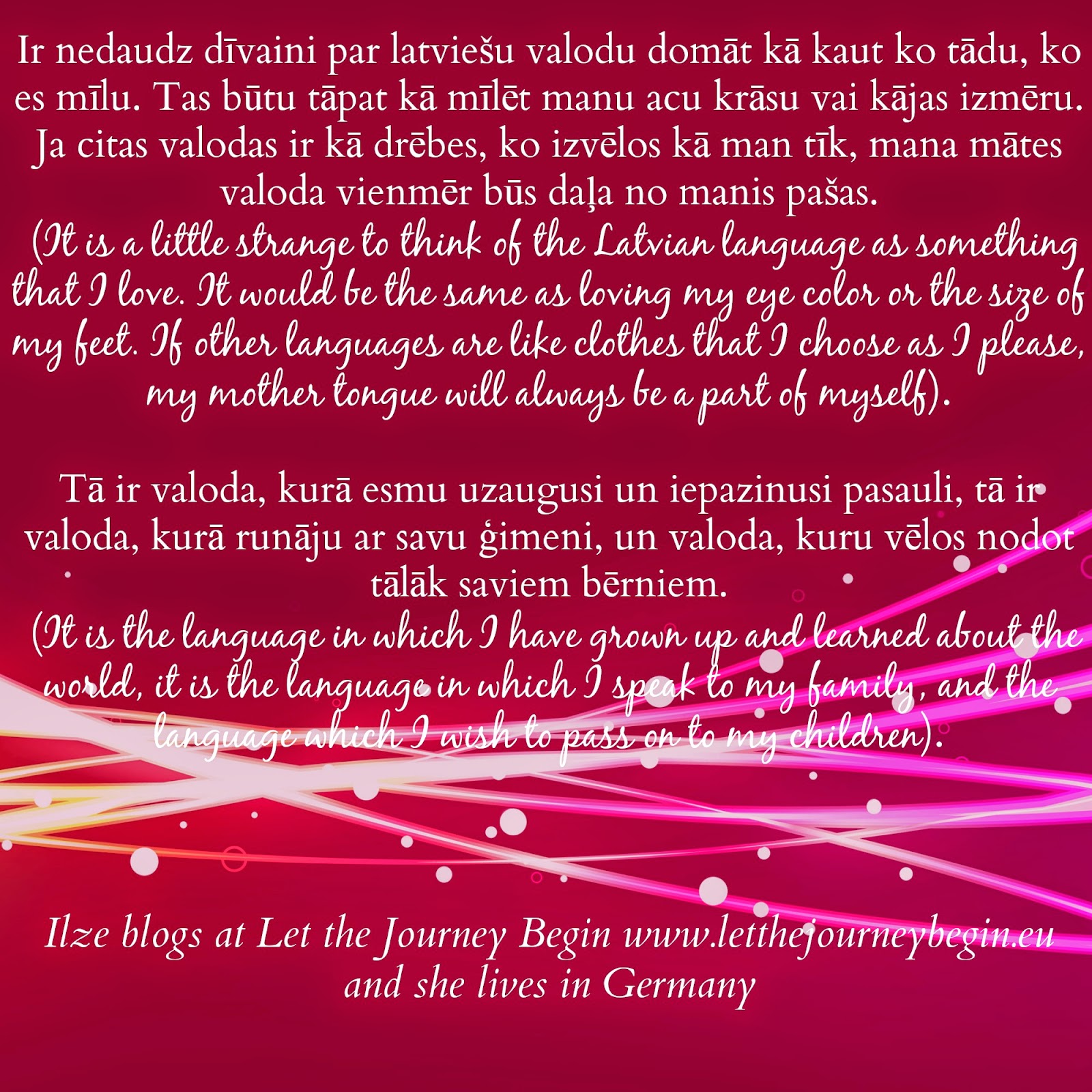
We will have now a travel across the globe, starting with Latvia.

 Let the Journey Begin www.letthejourneybegin.eu

Here comes Spanish with a Mexicana woman (bilingual Spanish and French):


Traveling to Asia, we have Persian:


Further East, we encounter Korean:


Catalan is a language I have never learned in my youth but I have heard it everyday... I understand it quite well when someone speaks it or when I read a text but can't speak it. I'm sad it's the case because it was my grand-father's language... but as I have never met him (he died when my mom was young), my mother and grand-mother couldn't pass it on to me... 


Poland is next with Olga!

The European Mama

We will have now a beautiful mix of Scandinavian languages, learned as a child by Rita:
www.multilingualparenting.com
Time for the 4th most spoken language in the world: Portuguese. I want to thank Daniela for her meaningful and beautiful answer.

Click on the picture to see it bigger!


This language is the most spoken as mother language in the world. Can you guess which one is it before scrolling to the end of the picture?


African languages, like I said earlier, are often learned at the same time as one of the European languages of the countries who colonised them in the 19th and 20th Century: Portuguese, French, English, Dutch, etc. Some are mostly oral languages and other can be written. But it doesn't mean many can write them. Education is rarely provided in these languages... It's why I love so much the programm of UNESCO. They try to help children to be scolarized in the main language and also in their local one (as much as possible).

My friend Jose is from Angola and lives in Germany. His mother tongues are Kiokue and Portuguese. He explained me that those are "his identity, his cultural instrument" and that writing african languages is sometimes quite difficult because of the phonetic. His use of Kiokue is essentially oral. Jose is also fluent in French and German, but don't start speaking English with him! You would make him loose his bright smile!

Ama is bilingual from birth in English and Twi. She lives in France (and had learned French). She can't write perfectly Twi, the alphabet is a bit complex, but told me she loves to use it orally at home with her children. Twi is for her a pictorial language, full of funny expression.

I will finish with Ute, who is a perfect bilingual since childhood in two european languages and is proof that those who say that learning several languages at the same time is "armful for the kids' brains" (one of the numerous myths about bilingualism...). She lives in the Netherland and blogs at expatsincebirth.com

Deutsch ist die Sprache meiner Familie, meiner Eltern und derer Vorfahren. Ich habe sie erst spät lieben gelernt, doch finde sie immer faszinierender und schätze den unermesslichen Wert des literarischen Erbgutes (German is the language of my family, of my parents and their ancestors. I learned to appreciate/love it quite late, but I find it more and more fascinating and I truly appreciate the immense value of the literary patrimony)
Deutsch ist wichting für mich, weil es meine Eltern und meine Kinder verbindet. (German is important for me because it connects my parents and my children)

L'italiano è la lingua del mio cuore. E' la lingua che ho scelto spontaneamente di parlare con i miei figli sin dall'inizio. E' la lingua delle mie emozioni e delle mie riflessioni più spontanee e profonde (Italian is the language of my heart. It's the language I chose spontaneously to talk with my children since the beginning. It's the language of my most spontaneous and profound/deep emotions)
L'italiano ha e avrà sempre un ruolo predominante nella mia vita perché è la lingua in cui riesco ad esprimere i miei pensieri più profondi e più accurati. Nonostante la situazione linguistica nella nostra famiglia sia cambiata rispetto all'inizio, considero l'italiano la lingua che più mi appartiene. Il fatto che la condivido con le persone a me più care la fa ancor più preziosa. (Italian is the most dominant language in my life because I can express my deepest and most accurate thoughts. Although the linguistic situation changed within our family (compared to the beginning), I consider Italian the language that pertains me the most. The fact that I share it with the most important people in my life makes it even more precious)

***


I wish you all a fantastic International Mother Language Day! And don't forget to share your love of your Mother tongue in the comments!


For more article about this event, search for the hashatg #IMLD!


LinkWithin

Related Posts Plugin for WordPress, Blogger...