Affichage des articles dont le libellé est Spirituality / Spiritualité. Afficher tous les articles

vendredi 26 mai 2017

As people of faith (Guest post from Sarah Ager)

Ramadan is starting tomorrow, Saturday 27th, 2017. Here is a guest post from Sarah Ager - a Christian UK girl who converted to Islam and is now happily married to a Muslim man and lives in Italy - who is the curator of Interfaith Ramadan (this text was written in 2016, but I kinda lost her text until this week when I found it by accident on my computer... God moves in mysterious ways):

le coran image pexels.com

As people of faith, we sometimes act under the assumption that ours is the only way of perceiving God. We hold this view even though Muslims make up only a seventh of the world's population. We sometimes forget that we live in a multi-cultural world alongside people of many diverse beliefs and faith backgrounds, who have their own unique ways of approaching and perceiving the Divine.

There are many lenses through which people perceive the world – the Bible, the Torah, the Qur'an, the Bhagavad Gita – to name just a few. There are a wealth of religious and non-religious texts which guide people in their daily lives – just as the Qur'an acts as a moral compass for Muslims.

In our increasingly globalised world, constant contact with other backgrounds and faiths make it imperative to learn more about the diversity of our neighbors because we are all an intrinsic part of the communities in which we live. Developing mutual respect, rather than merely tolerating one another, is not something that can be learned overnight. Through reaching out and speaking openly we can begin to nurture genuine appreciation for the ways others express their faith.

Without education, we can all too easily develop an irrational fear and mistrust of those we deem to be 'other'. This is especially true between people of different faiths, and when political groups, individuals, and certain factions of the Media so often seek to divide by exploiting and exaggerating religious difference.

Fear and mistrust of people based on assumptions of race or faith are at the core of countless acts of discrimination. To overcome this problem, we need open and constructive communication – the foundation of all positive relationships.

Through interfaith, an all-encompassing and inclusive way of interacting with one another, we endeavour to transcend human-made boundaries and make personal connections with people from all faith and non-faith backgrounds. Interfaith invites us to come as individuals with personal stories rather than being burdened with collective responsibility and representation of an entire faith community. Through sharing we gain greater understanding and become more inclusive in our interactions with the people around us.

As a Muslim from a predominantly Christian family, my inspiration for promoting interfaith is not only social, as a means of strenghtening ties with family and friends, but also deeply spiritual. Interfaith is not a foreign concept to Islam, it is in fact an intrinsic part of our faith. Within the pages of the Qur’an, we are called to protect “cloisters and churches and synagogues and mosques, wherein the name of God is oft commemorated” (Qur'an, 22:40). In his lifetime, Muhammad 
 encouraged and was actively involved in interfaith.

On one such occasion, Muhammad 
 met with a delegation of Christian Chiefs from Najran and together they signed a peace treaty which included the terms;
No compulsion is to be on them. Neither are their judges to be removed from their jobs nor their monks from their monasteries. No one is to destroy a house of their religion, to damage it, or to carry anything from it to the Muslims' houses. Should anyone take any of these, he would spoil God's covenant and disobey His Prophet.”

Alongside the promise that the Christians of Najran could worship freely, the treaty also included the understanding that “their Churches are to be respected. They are neither to be prevented from repairing them nor the sacredness of their covenants,” meaning they would be able to uphold their faith tradition alongside Muslims in the Arabian Peninsula.

It is clear that building strong communities by taking care of all those within it is an integral part of Islam and should be considered the duty of Muslims who strive to please Allah. The fighting we see between faith groups,  and even within them, hurts the whole community and goes against the golden rules of each faith, from the Christian concept of loving our neighbour and the Islamic principle that doing harm to another human being is as if you have hurt the whole of mankind, symbolising our intrinsic interconnectness.

Present day examples of interfaith in action include the iconic images of Muslims protecting Coptic Christians in Egypt during the 2011 Arab Spring and more recently, Christians providing refuge for persecuted Muslims in the Central African Republic despite the serious risk to their own lives. On a smaller but no less significant scale, there are regular and heartening stories of religious groups coming together to help other groups in times of need, from churches providing safe spaces for Muslims to pray during far-right protests in various European cities, to Muslims looking after synagogues in Kolkata.

On a more local level, Interfaith helps us to develop new and comprehensive ways of speaking in our daily lives that respects differences, and brings people together based on shared values. This inclusivity feeds into all our relationships, with family, friends, co-workers etc, and is particularly relevant for converts who have non-muslim family members or those in interfaith families. The tools of interfaith can also aid us in much needed intrafaith dialogue, creating stronger ties between different groups under the umbrella of Islam.

Although Interfaith dialogue invites us to share our personal experience of faith, we should remember that interfaith is not about throwing a net to catch potential converts. Critics of Muslim-based interfaith initiatives have argued that it's cleverly disguised dawah of the "creeping sharia" variety. Similarily, many Christian websites have written articles which recommend interfaith dialogue as a way of proselityising and essentially going undercover to gather information about how best to convert members of certain religious or secular groups. It is important to recognise the fine line between education and evangelism. Trust is crucial for open dialogue but it cannot develop if we suspect the other party is trying to boost their own numbers. Instead, interfaith offers us a safe space where we are able to come together, explore our similarities, change stereotypes, and build relationships based on constructive communication.

For people of faith, learning about other religions allows us to gain insight into how others worship and, ideally, helps us to deepen our connection with God while honouring our own faith tradition. Interfaith dialogue and hands on engagement provides us an opportunity to gain insight into our own tradition as we explain our beliefs to others and in turn learn how how faith is viewed through the lens of other faith traditions. In his book 'The Good of Religious Pluralism, Austrian-American sociologist Peter Berger states that 'pluralism influences individual believers and religious communities to distinguish between the core of their faith and less central elements'. As a result of pluralism, Mormon writer Daniel Peterson believes that we not only gain intellectual benefits from engaging with other but  we also 'become better by interacting with people different from ourselves.' People of diverse faiths share a common journey as learners and as seekers towards a better self and a better faith community in which we are a part.

Although we may be strolling down different paths, we are all on journeys seeking to find meaning in our lives, be our best selves, and for those who have faith, grow closer to our Creator. Interfaith dialogue reminds us of how much richer our lives can be when we strive towards these goals hand in hand.


lundi 30 mai 2016

Refugees are already on a "Ramadan diet" (and ways to be charitable with them) [MKB Ramadan for Kids]


Fasting, praying, being mindful of what you do, being charitable... those are principles that Muslims follow diligently during the month of Ramadan.

I'm not a Muslim woman, neither am I a refugee. But I have eyes to see what is happening in many parts of the world. And I have a heart too, a big crushed one. How could it not be so?

Some of my friends have met, teached, played with refugees from different countries in camps here in Germany, or in Greece or in Calais, France. They have shared the stories they have heard, orally, in blog posts or even in a talk broadcast in the whole world. Those stories that make us want to shout how unfair life can be, how some people are more monsters than people...

“World's refugees and displaced exceed record
60 million: U.N.” from 
reuters.com.


Refugees who are also Muslims may want to follow in one week this principle of Islam and fast everyday for 30 days. But how many of them have the requirred medical condition to properly do it? How many are underfed, sick, in dirty places and without access to proper food for the festivities? Far too many. 


I think that the refugees are already on a "Ramadan diet": less food, seeking opportunities to do good and for someone to be good to them, pondering every moves and travels, praying to Allah to be protected and stronger for their family, and so forth.


Their lifes are at risk, their past and home have been pushed aside, and they have faced such hardships, even for some torture (psychological and physical) and rape. They have witnessed their loved ones die, from bombing, shooting while crossing the borders or drowing in the Mediterranean see because the boat is too small, the sea too dangerous or the coast guards are pressuring them to back off...


So this Ramadan, I would encourage you -and your whole family- to think of them and share goodness around you. When lots of them are parked in camps and can't do anything beside waiting for a hypothetical approval to live in a new country, show them some love.


  • Fast from sunrise to sunset one, two or more days, and give the amount of money equal to the meals you didn't eat to a local organization helping homeless people. (Muslims tend to give the Zakat - the offering - during Ramadan, which is understandable as we draw closer to the divine while fasting and praying. Being more generous and humble comes from a higher spirituality.)

  • Start a relief project with children from a school, a local youth association, etc, aimed at helping people to better integrate in your community. Find ways to be creative and practical. Simple acts can do lots of good!

  • If you live near a camp or a shelter for refugees, meet the local managing team and ask them what they need the most AND what is possible to bring to them in term of food (Is home cooked food ok? Do they have an oven?...)

I wish to all my Muslim friends "Ramadan Kareem"! (a noble/generous Ramadan)


Ramadan for Kids 2016 | Multicultural Kid Blogs

Multicultural Kid Blogs is proud to be hosting its second annual Ramadan for Kids blog hop, where bloggers come together to share ideas for teaching kids about and honoring Ramadan. Don't forget to check out our series from last year and follow our Ramadan board on Pinterest for even more ideas and link up your own posts below!


Participating Blogs


mardi 22 mars 2016

Alexandra David-Néel [Women's History Month]

Par Alessondrad — Travail personnel, CC BY-SA 4.0


Alexandra David, en 1886,
le jour de sa présentation à la Cour de Belgique,
devant le roi Léopold II et la reine Marie-Henriette.
Alexandra David-Néel was a Belgian-French woman reknown for being the first foreign woman to visit and stay in Lhasa, Tibet. She had many chapters before and after that event in her adventurous life: explorer, anarchist, opera singer, spiritualist, Buddhist and writer.

During her trips in Asia, she met and talked with the 13th Dalaï Lama, befriended Maharaj Kumar (crown prince) Sidkeong Tulku Namgyal of the kingdom of Sikkim, learned meditation techniques and buddhist philosophy from Lachen Gomchen Rinpoche for several years, visited without authorisation Tibet and met the Panchen Lama, was expulsed from India ("thanks to missionaries" that were not thrilled with her being so well accepted by Tibetan people), traveled to Japan, Korea, China, Mongolia and finally came back to Tibet.

In 1924 -she was 56 years old-, under the disguise of a beggar, she stayed two months in Lhasa. Even if she knew the Dalaï Lama, she couldn't announce herself to him because of the ban (no foreigners in Lhasa).

She came back in France one year later and bought a house in Digne-les-Bains, where she wrote many books. Her companion of adventures for 11 years (she met him in 1914, he was 15 years old) Aphur Yongden came with her. She adopted him as a son.

She traveled again in China and Tibet between 1937 and 1946. Her retreat in Tibet lasted five years. She definitly came back to France in July 1946.

If you want to learn more about her life, I advise you to visit the website of the association managing her home Samten-Dzong or "fortress of meditation"in Digne-les-Bains, France, where she died at nearly 101 years old.


The following videos will show you how an adventurous, spiritual and smart woman she was.

Her life in pictures:

A video in French, but you can add subtitles: a portrait by her friend Marie-Madeleine Peyronnet, her biographe, and by Priscilla Telmon who went to Lhassa.
Portrait d'Alexandra David Neel la célèbre exploratrice et écrivaine bouddhiste
commenté par sa secrétaire et amie, Marie Madeleine Peyronnet, sa biographe 
et par Priscilla Telmon qui a marché dans ses pas jusque Lhassa.

Alexandra David-Neel: A Tibetan Buddhist Journey - Clare Fischer


This is the summary of The Secret Oral Teachings in Tibetan Buddhist Sects by Alexandra David-Neel, lama Yongden, H. N. M. Hardy, Alan Watts.

Interview of Alexandra David-Néel a few days before her death.

One house, one artist: (in French)


Women's History Month Series on Multicultural Kid Blogs

Join us for our second annual Women's History Month series, celebrating the contributions and accomplishments of women around the world. Follow along all month plus link up your own posts below! Don't miss our series from last year, and find even more posts on our Women's History board on Pinterest:


March 1
A Crafty Arab on Multicultural Kid Blogs: 7 Women Artists Who Changed History

March 3
The Art Curator for Kids: Songs We Can See - The Art of Peggy Lipschutz

March 4
Kid World Citizen: Children's Books about Women Scientists

March 7
Mama Smiles: Picture Books about Great Women in History Your Kids Need to Know

March 8
Hispanic Mama: 4 Latina Women Who Made It Happen

March 9
Discovering the World Through My Son's Eyes: Spanish Children's Book on the Life of Felisa Rincón de Gautier, First Female Mayor of San Juan, Puerto Rico

Colours of Us: 28 Multicultural Picture Books about Inspiring Women & Girls


March 10
Witty Hoots: Some Awesome Women in My Life

March 11
MommyMaestra: Women in World History Trading Card Template

March 14
Crafty Moms Share: The Thinking Girl's Treasury of Real Princesses

March 15
The Jenny Evolution: Non-Fiction Books about Women for Kids

March 16
Discovering the World Through My Son's Eyes

March 17
Living Ideas

March 18
La Cité des Vents

March 21
A Crafty Arab

March 22
La Cité des Vents

March 23
Peakle Pie

March 24
All Done Monkey

March 25
The Art Curator for Kids on Multicultural Kid Blogs

March 28
Creative World of Varya

March 29
Family in Finland

March 30
The Jenny Evolution

March 31
For The Love of Spanish


Creative Kids Culture Blog Hop

vendredi 11 mars 2016

La procession de la Sanch [Easter around the World]

Départ de la procession, avec au fond, la croix des anciennes confréries de Perpignan (gantiers, tisserands, jardiniers, etc).
Start of the procession, with in the background the cross of the ancient fraternities of Perpignan (gloves makers, weavers, gardeners, etc).

Vendredi Saint, dans les rues du Vieux Perpignan. Que le soleil rayonne ou qu'il pleuve à la mode méditerranéenne (bien fort pour quelques heures), la procession de la Sanch (= du sang) commémorant la Passion et l'Agonie du Christ s'ébranle à 15h depuis l'église St Jacques. Passant par les rues et ruelles médiévales et faisant deux arrêts - 16h à la cathédrale St Jean et 17h à l'église St Matthieu-, les misteris retourneront juste à côté de leur point de départ, aux jardins de la Miranda. Un lieu qui d'ailleurs n'est pas que géographiquement leur départ mais surtout historiquement.
Good Friday, in the streets of the Old Perpignan. Sun shining or mediterranean rain pouring (very heavy for a few hours), the Sanch procession (= the blood) commemorating the Passion and Agony of Christ starts at 3pm from the church of St James. Walking through the medieval streets and alleys and stopping two times - 4pm at the Cathedral St John and at 5pm at the church of St Matthew -, the misteris will go back near their starting point, in the gardens of the Miranda. A place that is not only the geographic start but also the historical one.


Image: L'Indépendant.


Historique de la confrérie et tenue d'un pénitent / Hictoric of the Fraternity and clothes of the penitent:

Le 11 octobre 1416, la " Confrérie du Précieux Sang de Notre Seigneur Jésus-Christ " y fut fondé par Saint Vincent Ferrier. Ses buts étaient / sont:
The 11th of October 1416, the "Fraternity of the Precious Blood of Our Lord Jesus Christ" was founded by Saint Vincent Ferrer. The aims of this fraternity was:

• l'accompagnement des condamnés à mort (par le passé) / support to the people sentenced to death (in the past)

• la visite et l'accompagnement des prisonniers / visiting and supporting the prisoners

• la participation aux cérémonies liées à la Semaine Sainte ainsi qu'une pratique religieuse réelle et active / participation in the ceremonies during the Holy Week and also a sincere and active religious practice

• la participation aux diverses maintenances (renforcement des liens de coopération et d'entraide entre les différentes Confréries de Pénitents de France et de la Principauté de Monaco / participation in various maintenances (building stronger bonds  of cooperation and relief between the different Fraternities of Penitents in France and Monaco)


Penitent

La confrérie des Jardiniers (Hortolans) et celle des Tisserands (Teixidors) existaient déjà dans la paroisse  St Jacques et leurs membres furent les premiers pénitents dans leurs sacs noirs et encapuchonnés (les caparutxes). La cagoule qu'ils portent permettait aux pénitents qui avaient un passé criminel de pouvoir prendre part à la procession et invoquer le pardon divin au milieu des autres habitants. La tradition est restée, ainsi que le nom qui a vite désigné l'ensemble de leur tenue noire ou rouge. Pour connaître la paroisse d'origine d'un pénitent, c'est la couleur de la ceinture de corde qui ceint sa tenue qui vous l'indiquera (blanc pour La Réal, rouge pour St Jacques, etc). Les pénitents portent des chaussures noires ou bien vont pieds-nus. Autour du cou, le scapulaire -objet de dévotion béni par l'évêque- est attaché et passé sous le sac (sorte de robe) du pénitent.
The Fraternity of the Gardeners (Hortolans) and the one of the Weavers (Teixidors) existed then in the St James parish and their members were the first penitents in their black bags and hoods (the caparutxes). The cowl they are wearing allowed the penitents who had a criminal record to take part in the procession and to invoke the divine forgiveness in the middle of the other inhabitants. The tradition stayed, as did the name which quickly designated their whole clothing, black or red. To know from which parish they are from, it's at the color of their rope belt you will see it (white for La Réal, red for St James, etc). the penitents have to wear black shoes or they can go barefoot. Around their neck, the scapular -an object of devotion blessed by the bishop- is attached and hid under their bag of penitent (a kind of dress).


L'ordre et la composition de la procession / Order and composition of the procession:

Le Regidor et sa cloche de fer
The regidor and his iron bell
  • le Regidor de procession, caparutxa rouge écarlate, ouvre le cortège avec dans ses mains la cloche de fer qu'il fait retentir à intervalles réguliers. / the Regidor of the procession, with a scarlett caparutxa, opens the procession with an iron bell in his hands, that he will ring from time to time. 
  • les tambours, voilés de crêpe noir. Des chants accompagnent la processions: les goigs de la Sanch. / the drums, veiled in a black mourning crêpe. Hymns support the penitents: the goigs of the Sanch.

  • les Misteris: ces groupes statutaires portés à main d'homme en capuchons noirs ou rouges, ou de femme en mantilles, pendant trois heures, représentent les scènes de la Passion du Christ. Chaque pénitent porte 30 à 50 kg et ils sont 8 pour en transporter un Misteri, qui de plus est toujours orné de fleurs. / the Misteris: group of statues hold by men in caparutxes black or scarlett, or women in mantilla, during three hours, representing scenes from the Passion of the Christ. Each penitent holds between 30 and 50 kg and they are 8 to carry one, very decorated with flowers, Misteri.


Les Misteris que vous pouvez voir lors de la procession sont au nombre de 36 et évoquent les scènes suivantes: / There are 36 Misteris you can see during the procession and they show the following scenes:


  • l'Hort (= le jardin) porté par la Confrérie des Jardiniers et abondamment fleuri / the Hort (= the garden) carried by the Fraternity of the Gardeners and beautifully flowered.
  • la Flagellation / the Whipping
  • le Couronnement d'épines / the Crowning of thorns
  • l'Ecce Homo. Les porteurs du misteri de l’Ecce homo (présentation à la foule devant le palais de Pilate, de Jésus battu et couronné d’épines) sont habillés de vermeil - comme le Regidor - pour rappeler le sang du Christ. / the Ecce Homo. The bearers of the Ecce Homo (when Jesus, whipped and crowned with thorns, is presented to the crowd by Pilate) are clothed in vermeil - as the Regidor - to remember Christ's blood.
  • les Misteris de Jésus portant la Croix / the Misteris of Jesus walking with the Cross
  • les Misteris du Christ cloué sur la Croix / the Misteris of Christ on the Cross

  • le "Dévot Christ" placé sur le parvis de la cathédrale dans son lit d'apparat / the "Christ Devout", is placed on the cathedrale's square, in its ceremonial bed.
Christ Devot

  • la Mater Dolorosa: Marie au pied de la Croix, son coeur en argent transpersé de 7 glaives (ses  douleurs) / the Mater Dolorosa: Mary at the cross feet, her silver heart being pierced by 7 swords (her pains)
  • la Pieta: Marie portant le corps de Jésus après qu'on l'est descendu de la Croix / the Pieta: Mary holding Jesus' body after they took him down of the cross.
  • la Soleda: Marie regardant la croix où son fils a été supplicié quelques heures plus tôt, son corps reposant désormais au sépulcre / the Soleda: Mary looks up at the cross where her son has been tortured a few hours ago, his body laying in the sepulcre.
La Soleda

Deux autres processions de la Sanch existent en Catalogne du Nord: à Arles-sur-Tech et à Collioure et une en Catalogne du Sud, à Gérone.
Two other Sanch processions exist in North Catalunya: in Arles-sur-Tech and in Collioure, and one in South Catalunya in the city of Gerona.

J'y ai assisté deux fois, parmi la foule "silencieuse", et bien qu'à l'époque je n'appartenais à aucune religion, la vie du Christ me touchait déjà beaucoup et je me considérais déjà comme chrétienne. Ces statues et la ferveur dans le regard des pénitents et pénitentes m'avaient beaucoup intéressé.
I watched the procession two times, in the "mute" crowd, and even if at that time I didn't belong to any religion, the life of Christ was already deeply touching me and I considered myself as a Christian. Those statues and the fervour in the eyes of the penitents interested me a lot.


Si vous avez l'occasion de venir à Perpignan au moment de la Semaine Sainte, la procession de la Sanch est une célébration à ne pas rater! Surtout que 2016 marque le 600e anniversaire! Le Festival de Musique Sacrée se déroule également à ce moment-à. De même vous pouvez aller le Lundi de Pâques à Ille-sur-Têt pour la procession du Ressuscité. Et puis, les Pyrénées-Orientales regorgent de trésors architecturaux et naturels... pourquoi se priver d'une belle balade?
If you have the opportunity to come to Perpignan during the Holy Week, the Sanch procession can't be ignored! Especially as 2016 is the 600th anniversary! The Sacred Music Festival takes place at the same time. On Easter Monday, you can drive to Ille-sur-Têt to see the procession of the Risen Christ. And also, the Pyrénées-Orientales area abouds with architectural and natural treasures... why would you deprive yourself of a nice roadtrip?


A lire: Article sur les 600 ans de la Sanch publié le Mercredi 23 mars 2016 sur le site L'Indépendant.fr.


Un grand merci à Zebulon nog s3
qui a accepté que j'utilise ses photos de la Sanch 2015 pour illustrer mon article.

A big thank you to Zebulon nog s3
who agreed for me to use his photographies from the Sanch 2015 to illustrate my post.


This post is part of the series Easter around the world 
from Multicultural Kid Blogs. 
Be sure to look at what the bloggers have written 
about Easter in different countries!


Explore the diverse traditions of Easter around the world with us, and don't miss our series from last year and this wonderful overview of global Easter traditions. You can also find these posts and more on our Easter Around the World Pinterest board:

March 21
Kori at Home
March 24
Hispanic Mama


Creative Kids Culture Blog Hop

mercredi 16 décembre 2015

"Mary, Did You Know?" A modern Christmas classic

Drums, bells, piano, violin, or guitar playing our favorite Christmas tunes can be heard in the malls and on many radios. Some are so well known that you can whistle them on your own and other are more "mysterious" for our ears.


Today, I would like to talk about one of my most beloved Christmas songs Mary, Did You Know? I discovered this song a few years ago, thanks to my american friends. The melody enraptured me and the lyrics. Oh the lyrics! [Some would say that the question (the one in the title) is a bit redundant and that Mary, yes, knew. Guess what? It's a poem, a song! Stop being picky...]

In the Bible, it is said that an angel told her that the baby who will soon grow in her wombs, would be the Son of God. Of course she knew that her son should be unique and powerful. She was educated in the ways of God. She knew of the prophecies of old. And she was witnessing the homage from the sheperds, and probably was feeling the Holy Ghost and the angels' presence in the stable.

However, she was a young woman, mother for the first time in her life. This baby was hers, so tiny, precious and fragile. His future was foretold, but right now SHE was the one who would hold him and protect him. She was amazed, tired and very much "in love" with her son. Metaphysic and spiritual questions may have come and go in her mind, but her heart and soul were at peace, and love was the most important feeling at that moment.


Lyrics (from Metrolyrics):

Mary did you know that your baby boy
Will one day walk on water?
Mary did you know that your baby boy
Will save our sons and daughters?

Did you know that your baby boy
Has come to make you new?
This child that you've delivered
Will soon deliver you

Mary, did you know that your baby boy
Will give sight to a blind man?
Mary, did you know that your baby boy
Will calm a storm with his hand?

Did you know that your baby boy
Has walked where angels trod?
And when you kiss your little baby
You've kissed the face of God

Oh, Mary did you know

Ooh...

The blind will see,
the deaf will hear,
The dead will live again

The lame will leap,
the dumb will speak,
The praises of the lamb

Mary did you know that your baby boy
Is Lord of all creation?
Mary did you know that your baby boy
Will one day rule the nations?

Did you know that your Baby Boy
Is Heaven's perfect Lamb?
This sleeping child you're holding
Is the great I am


The author of the song are Mark Lowry and Buddy Greene, and it was first recorded by artist Michael English in 1981. Numerous artists have sung this modern Christmas song in different musical genres.

I have shared in my last week post the oh so beautiful cover made by Peter Hollens on the 8th of December 2015 and which has already more than 3,5 millions views.

Let me today present you four other renditions:

Kenny Rodgers & Wynnona Judd

CeeLo Greene (OST of the movie the Son of God, in The Bible series)

Pentatonix

And my kids favorite version by Evie Clair (she's 12 years old!). They can't stop listening to it.

This Christmas, have a though for Mary, mother of Jesus, who knew from the time of His conception what her son will go through at the end of His mortal life.


For the Christmas playlist with several artists 
playing / singing Mary, Did You Know?

Creative Kids Culture Blog Hop

vendredi 6 novembre 2015

Ce qu'une naissance à domicile m'a appris sur l'expiation de Jésus

Je sentais que la naissance était proche. Cela faisait déjà une trentaine de minutes que je ne pouvais plus me concentrer aussi bien sur la gestion des contractions. J'avais trouvé ma position pour l'accouchement et mon mari me soutenait par sa présence et ses prières silencieuses.

De mon côté aussi, je priais. Je n'ai pas demandé moins de douleur, juste de pouvoir avoir suffisamment de force dans mes jambes (elles tremblaient et me faisaient souffrir au niveau des veines) pour amener ma fille jusqu'à sa naissance et être inspirée pour "pousser" au bon moment. L'enfantement est véritablement un moment de profonde communion entre une femme et Dieu (notre Père Céleste), ainsi qu'entre elle et Jésus à Gethsémanée.

Combien j'ai ressenti l'assurance de pouvoir y arriver "seule", comme j'ai été créée pour le faire. Grossesse physiologique, bébé de taille et de poids moyens, maman encore jeune... Pourquoi médicaliser ce moment intense, épuisant, joyeux et mémorable? Ce choix de naissance à la maison est une des meilleures choses qui me soit arrivé. Ma compréhension spirituelle du monde s'est améliorée, mon lien avec mon bébé est plus fort et intuitif que ne l'a été ceux avec mes deux premiers enfants - et même si je sais que je n'étais pas prête à l'époque pour un accouchement sans péridurale, surtout dans le cas du second qui a été déclenché, je ne peux que regretter de ne pas avoir eu ce lien si puissant avec mon fils et ma première fille.

Lorsque la naissance se rapproche, les parturientes ont tendance à paniquer. Gérer les contractions devient plus difficile. Si au début du travail j'ai pu utiliser la technique de visualisation pendant chaque contraction et ainsi rester "détendue" et calme, dès le moment où le bébé a commencé sa descente et que l'envie de pousser a pointé le nez, mon esprit s'est laissé emporté par toutes les sensations de mon corps. Heureusement pour moi, j'ai beaucoup lu et étudié pendant ma grossesse. Je m'attendais à ce changement. Et au lieu de paniquer et dire que j'avais besoin d'être anesthésié, et bien que j'ai laissé échappé quelques "aide-moi" à ma sage-femme (et des "aïe-aïe-aïe"), je me suis "laissée faire". Je savais que la douleur allait être juste pour un moment.

Ma foi m'a également portée. Une des sages-femmes m'a surnommée "Power Frau". Il faut dire qu'Alice est sortie en une grande poussée. Et que j'ai dû être patiente pour que la délivrance soit complète (le cordon faisait presque 1 mètre!) A aucun moment je n'ai été désespérée ou anxieuse. Certes, je commençais à être fatiguée, mais je savais et ressentais que je n'étais pas seule, qu'il y avait une force, une énergie (donner le nom que vous voulez...) près de moi, autour de moi et j'ajouterai même EN moi. 

Comme la visualisation n'était plus possible pour ne pas me laisser submerger par les contractions, j'ai pensé à Jésus priant à Gethsémané et ressentant toutes les douleurs que les humains subissent. La douleur de l'enfantement, les "horreurs" que certaines femmes subissent à ces moments-là, il les a ressenti lui-aussi. Pour être notre avocat lors du Grand Jugement, il a tout expérimenté en quelques heures. Mes pensées alors que mon corps était en train de donner la vie se sont tournées vers lui, vers le sacrifice incomparable qu'il a accepté de faire. Cette assurance que je n'étais pas seule dans ma "petite" souffrance m'a renforcé. J'allais donner naissance à ma fille, sans peur et sans problèmes. J'allais l'aimer et l'aider dans son développement, comme Dieu et Jésus-Christ nous aiment et nous aident. 

Parce qu'Il n'a pas pris que nos péchés et nos souffrances sur Lui, il a également une infinie compréhension de l'Amour, de toutes les qualités divines que les humains possèdent. Alors je fais des efforts au quotidien pour être une source d'amour et de réconfort pour mes enfants. C'est un long chemin, où je trébuche souvent, mais au bout duquel je pourrai regarder le Seigneur sans regrets de ne pas avoir fait d'efforts. Je ne pense pas que j'aurai un autre enfant, alors cet accouchement à la maison, cette expérience que je garde précieusement en moi, est un rappel constant pour moi qu'avec Dieu et la confiance en nos capacités, soulever des montagnes - ou mettre des enfants au monde sereinement - c'est possible!


jeudi 2 juillet 2015

Les 5 Piliers de l'Islam vus par des Saints des Derniers Jours / The 5 Pillars of Islam from a LDS perspective.

Expliquer une autre religion à mes enfants: 
les Cinq Piliers de l'Islam.
Explaining another religion to my children: 
the Five Pillars of Islam.


Je pense que certains lecteurs se demandent pourquoi une "mormone" participe à une série d'articles sur le Ramadan et l'Islam. Et bien en fait, c'est assez simple. Je considère que mes enfants doivent recevoir non seulement une éducation religieuse au sein de notre foi, de notre Eglise, mais qu'ils doivent aussi être à même de comprendre le monde qui les entoure. C'est pourquoi je leur parle, selon les occasions qui se présentent (on passe à côté d'une synagogue ou d'une Eglise protestante, on parle de l'ancienne assistante maternelle de Gabriel qui est musulmane, etc) des autres religions existant dans le monde.
I think some readers will ask themselves why a "mormon woman" takes part in a series about Ramadan and Islam. Well, it's rather simple. I consider that my kids have to receive not only a religious education about our Faith, our Church, but also that they have to be aware and understanding of the world they live in. That's why I talk to them, on occasion about other religions existing in the world (like when we walk near a synagogue or a reform church, or when we speak about Gabriel's past nursery assistant who was muslim, etc).

Tous les Lundi soirs, nous avons une "soirée familiale" au cours de laquelle nous chantons des cantiques avec nos enfants, nous abordons un sujet concernant notre famille (lié en principe à l’Évangile), nous lisons une histoire tirée des Écritures et nous jouons à un jeu. Le Lundi 22 juin, alors que le mois de Ramadan avait déjà commencé, j'ai choisi comme thème de discussion en famille les "Cinq Piliers de l'Islam" et les correspondances que nous pouvions faire avec nos propres croyances.
Every Monday evening, we have a "family home evening" during which we sing hymns, children songs together, we talk about subjects important to our family (and linked to Gospel's principles), we read stories from the Scriptures and we play a game. On Monday 22th of June, while the Ramadan month had already begun, I chose for our talk's topic the "Five Pillars of Islam" and the correspondences we can make with our own believes.


Je me suis appuyée pour notre discussion sur un livre emprunté à la bibliothèque municipale d'Oberursel: Islam, par Neil Morris, collection "Die Weltreligionen".
I used as support for our talk the book borrowed at Oberursel's library: Islam, by Neil Morris, collection "Die Weltreligionen".


J'ai introduit les cinq devoirs essentiels que tout musulman fidèle (et ayant l'âge requis) se doit d'accomplir dans sa vie, pas vraiment dans l'ordre habituel, mais cela avait pour but de parler en dernier du jeûne et de l'aumône. Puis j'ai fait le lien avec nos pratiques et nos croyances, en lui posant des questions et lui rappelant certains principes de notre Eglise:
I introduce the five essential duties every faithful Muslim (and old enough to follow them) has to accomplish in his life, not really in the usual order, but it was to speak about fasting and offerings at last. Then, I draw parallels with our believes and practices, asking him and making him remember our principles:


1 - la Profession de foi : la Shahaada.
C'est ce qui est le plus important pour un musulman: l'attestation de foi de l'unicité de Dieu et du fait que Mahomet est Son prophète. Elle doit être dite sans contrainte et en toute connaissance de cause. Voici le texte de la Shahada en arabe (elle doit être dite en arabe pour être valide):
أشهد أن لآ إلَـهَ اِلا الله وأشهد أن محمدا رسول الله / Ašhadu an lā ilāha illa-llāh, wa-ašhadu anna Muḥammadan rasūlu-llāh
La traduction en français: Je témoigne qu'il n'y a de divinité que Dieu. Je témoigne que Muhammad est le messager de Dieu.

Pour nous, Saints des Derniers Jours, rendre témoignage de notre foi en Dieu, de ce que l'on croit et sait être vrai, est aussi un acte important. Il est recommandé d'étudier les Écritures, de prier à propos de chaque point de l’Évangile et de nourrir notre témoignage des réponses reçues à l'issu de ces prières ou lors d'expériences vécues. Une fois par mois, après l'ordonnance de la Sainte-Cène (équivalent de la communion chez les Catholiques...), des membres de l'assemblée qui en ont le désir peuvent se rendre au pupitre et rendre leur témoignage sur un point de doctrine.

The Profession of Faith: the Shahaada. 
It's the most important for Muslims: the testimonial of faith about the unicity of God and the fact that Mahomet is His prophet. She has to be said willingly and with a full knowledge of what it entails. Here is the text of the Shahada in Arabic (it's the language required to profess it for its validity):
أشهد أن لآ إلَـهَ اِلا الله وأشهد أن محمدا رسول الله / Ašhadu an lā ilāha illa-llāh, wa-ašhadu anna Muḥammadan rasūlu-llāh
The English translation: [ I testify that ] there is no god (allah), but God, and [ I testify that ] Muhammad is the messenger of God. (from Wikipedia)  or other version: There is no god but Allah, and Muhammad is his prophet.

For us, Latter-day Saints, to give a testimony in our faith in God, about what we believe and know to be true, is also a very important act. It's recommanded to study the Scriptures, to pray about each principles of the Gospel and to nourish our testimony with the answers we receive, after a prayer or during an experience we lived. Once a month, after the ordinance of the Sacrament (like the communion for the Catholics...), members of the assembly who wishes to do it can go to the pulprit and share their testimony on a doctrine point.


2 - la Prière quotidienne (5 fois par jour): le Salat (As-salaat).
Les musulmans prient cinq fois dans la direction de la Kaaba, qui se situe à La Mecque. Il n'y a pas d'endroit précis pour faire la prière, seuls comptent l'orientation, les mots / le texte, l'intention et la gestuelle.

Notre famille prie plusieurs fois par jour ensemble: le matin, avant chaque repas, avant de se coucher... Il y a également des occasions plus uniques telles un voyage en voiture, pour prendre une décision, pour demander de l'aide, etc. Nous prions aussi personnellement et en couple. Si les musulmans ont des prières écrites qu'ils doivent réciter, nos prières sont spontanées, à l'exception de la prière pour bénir le pain et l'eau lors de la Sainte-Cène chaque dimanche. Le début est une adresse à Dieu ("Cher Père Céleste" par exemple) et elle se termine par "Au nom de Jésus-Christ, Amen". Le reste, c'est au bon vouloir et besoin de chacun.

The daily prayers (5 times a day): the Salat (As-salaat).
Muslims pray five times in the direction of the Kaaba, located in Mecca. There's no precise place to do the prayers, what is required is the orientation, the text / words, the intend and the body movements.

Our family prays together several times a day: in the morning, before each meal, before we go to bed... There are more unique occasions too, like a long drive in the car, to take a decision, to ask for help, etc. We pray also in couple, and on our own. If Muslims have written prayers they have to recite, our prayers are spontaneous, at the only exception of the prayer for the blessing of the bread and water during Sacrament each Sunday. We start with an address to God (for example "Dear Heavenly Father") and end with "In name of Jesus-Christ, Amen". The need and the goodwill of each one will dictate the rest of the prayer.


3 - le Pèlerinage à La Mecque: le Hajj. A faire au moins une fois dans sa vie, si la personne a les moyens physiques et financiers le permettant, le pèlerinage déplace chaque année des foules de fidèles entre les 8 et 13 du mois de  Dhû al-hijja (douxième du calendrier musulman).

J'ai fait le rapprochement avec notre préparation et notre désir d'aller au Temple au moins une fois dans sa vie pour faire des Alliances avec Dieu, dont le Scellement des familles (familles unies pour l’Éternité). Pour beaucoup, cela demande comme pour nombre de musulmans de voyager loin, de se préparer spirituellement et d'être en accord avec les principes divins.

The pilgrimage to Mecca: the Hajj. To do at least once in a lifetime, if the person has the physical capabilities and finances to permit it, the pilgrimage move each year a huge crowd of faithful believers between the 8th and the 13th of Dhû al-hijja (twelveth month of the Muslim calendar).

I made the link with our preparation and our desire to go to the Temple at least once in our life, to do Covenants with God, among them the Sealing of the family (families are united forever). For many, it asked like for many Muslims to travel far away, to be spiritually prepared and to agree with the divine principles.


4 - le jeûne du mois de Ramadan: le Saoum.
Jeûner commence au lever du soleil et ne se termine que lorsque le soleil est couché. Après, il est de coutume de rompre le jeûne en famille ou entre amis. Pour plus d'informations sur ce que mangent les musulmans durant Iftar (le repas durant lequel on casse le jeûne chaque soir), je vous conseille cette liste de recettes et menus pour Iftar (en anglais).

Dès que j'ai parlé de jeûne, mon fils a dit "Papa aussi il le fait!" Bon, Maman jeûne également... quand elle n'est pas enceinte ou qu'elle allaite. En fait, c'est une fois par mois, en général le premier Dimanche de chaque mois, pendant deux repas consécutifs. Pas d'aliments ni de boissons, si bien sûr la personne en est physiquement capable. La raison de ce jeûne est la même que pour les musulmans: se rapprocher de Dieu, être plus en phase avec nous-même et notre environnement, s'ouvrir aux autres...

The fast during the month of Ramadan: the Sawm.
Fasting begins as soon as the sun rises and end when after the sunset. After the fast, it's customary to break it with the company of family and friends. For more informations about what Muslims eat during Iftar (the meal that breaks the fast each evening), I advice you to read this list of Iftar menus and recipes.

As soon as I have talked about the fast, my son said "Daddy do it too!" Well, Mommy fasts too... when she's not pregnant or breastfeeding. In fact, we do it once a month, usually the first Sunday of the month, during two consecutive meals. No food, no drink, if of course someone is physically able to do so. The reason behind this fast is rather the same as for Muslims: to grow closer to God, to be more in tune with ourselves and our surrounding, to open ourself to others...


5 - la Charité avec les aumônes: la Zakat
Bien souvent, cet impôt volontaire est payé au moment du Ramadan et représente environ 2,5% des revenus. Toutefois, la Charité est également développée en famille en rendant des services autour de soi.

Dans mon Eglise, il est demandé (mais c'est au libre-choix de chacun) de reverser le montant des deux repas jeûnés chaque mois au "fond de jeûne". L'argent récolté sert en premier pour aider les familles nécessiteuses de la paroisse ou du pieu (regroupement de paroisse, équivalent d'un diocèse), ou des personnes hors de l'Eglise lors de catastrophes naturelles. [Un fond humanitaire spécial a d'ailleurs été créé il y a trente ans à cette fin. Voir mon article sur le blog anglophone Interfaith Ramadan qui paraîtra le 7 juillet.]

The Charity with the yearly alms: the Zakat.
These alms are often given during Ramadan, are always based on the will of the people and represents roughly 2,5% of their wages. However, Charity is also developped at home by serving others (see this lovely article C is for Charity).

In my Church, it is asked (but it's based also on free-will) to offer the amount we would have paid for the meals during fast to the "fast offerings fund". The money received will be used primarily in the ward (=parish)  or the stake (= diocese) to help the needy families, or it could also be used in case of natural disasters. [A humanitarian fund has also been especially set up 30 years ago with this goal. You can read my post on Interfaith Ramadan that will be publish on the 7th of July.]


    Je tiens à vous parler d'Amanda, auteure du blog MarocMama et américaine convertie à l'Islam, qui a réalisé en novembre 2013 une série d'entretiens croisés avec une blogueuse "mormone". Je vous conseille vivement de lire leurs articles, qui sont par contre en anglais. Carissa (la "Mormone") a écrit les articles suivants. Amanda a quant à elle publié sur le blog de Carissa des textes expliquant l'Islam, comment elle élève ses enfants, et aussi démystifiant certains préjugés. Elles ont toutes deux tiré de cette expérience de belles leçons de partage, d'amitié, de respect et le désir de lutter contre les discriminations qu'une personne d'une autre foi, un autre avis que le nôtre, peut rencontrer.
    I want to talk to you about Amanda, author of the blog MarocMama and american woman converted to Islam, who realized in November 2013 a few crossed interviews with a "mormon" blogger. I deeply recommend you their posts. Carissa (the "mormon" mom) wrote these articles and Amanda published on Carissa's blog these posts explaining Islam, how she raises her kids and fighting misconceptions. They have both learned from this experience lessons about friendship, respect, sharing, and the desire to fight against discriminations faced by someone from a different faith, a different opinion.


    Pour des idées d'activités créatives sur les Cinq Piliers de l'Islam, voir les liens suivants:
    * carillon en perles "Cinq Piliers de l'Islam"
    * magnets (à l'achat)
    * et toutes ces idées pour enfants: tableau Pinterest

    For craft ideas about the 5 pillars of Islam, here are some links:
    * Wind chime "Five pillars of Islam"
    * magnets (you can buy them)
    * and all those ideas for children: Pinterest board.


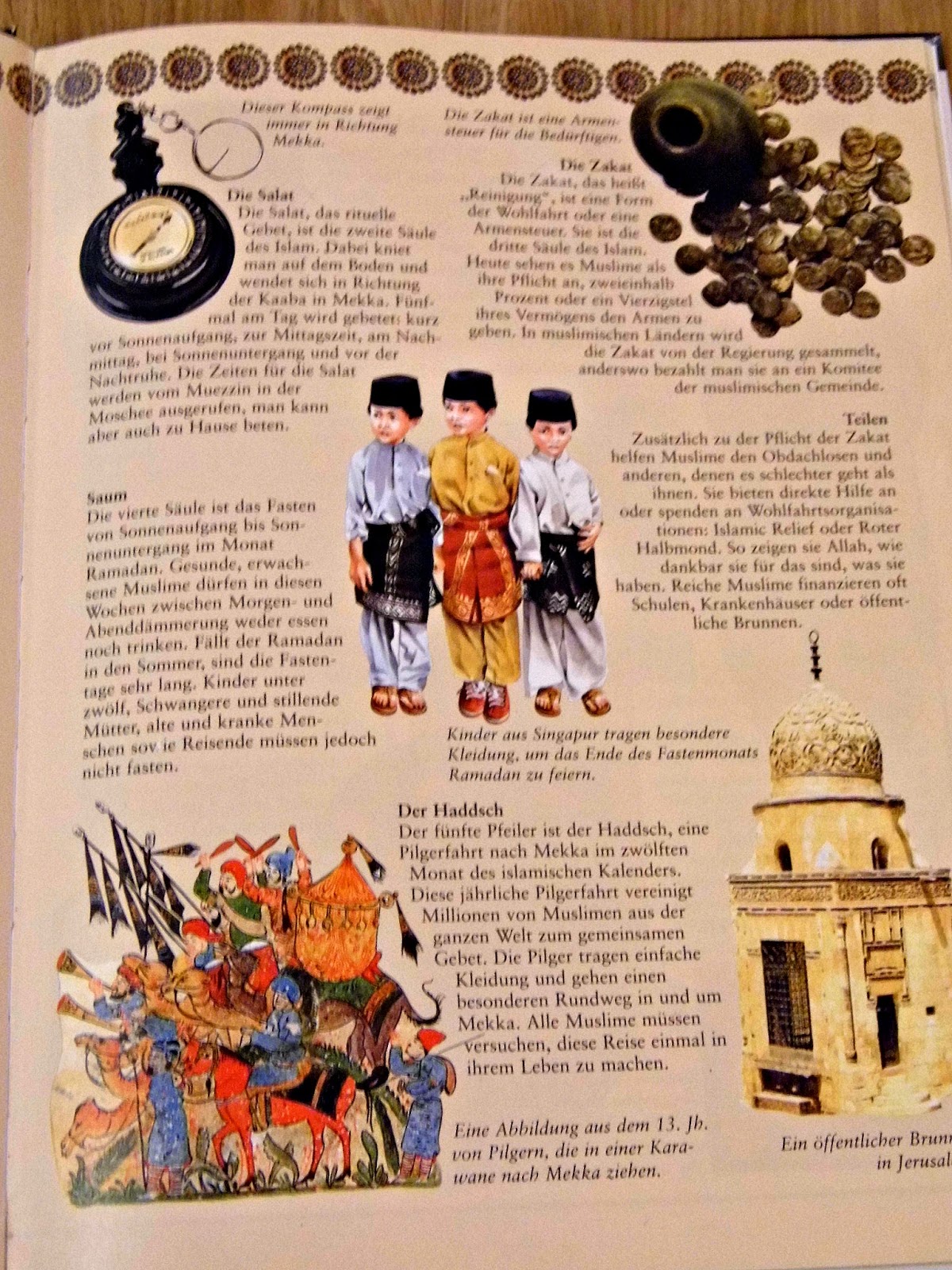
    Dans le livre que j'ai utilisé avec mes enfants, plusieurs autres caractéristiques de l'Islam sont aussi abordés:
    In the book I used with my children, several other characteristics of Islam are explained:
    Table des matières, livre Islam, Neil Morris.
    J'apprécie toujours lorsqu'un livre pédagogique a de belles illustrations.
    Table of contents, book Islam, by Neil Morris.
    I really like when a pedagogic book has many beautiful pictures.

    Double page sur la prière: comment un musulman prie, dans quel lieu, les occasions de prière, etc.
    Double page about prayer: how a muslim pray, where, for which events, etc.

    Double page sur les fêtes dans l'Islam.
    Double page about the Islamic festivals.
    J'ai encore deux semaines pour finir de lire ce livre avec mon fils (ma fille de trois ans ne reste pas en place pendant les explications...mais bon, elle est encore bien jeune!). J'espère qu'après il aura envie de se renseigner un peu plus sur le sujet ainsi que sur d'autres religions. Je vais essayer de trouver un livre sur le judaïsme à notre prochain arrêt bibliothèque, mais ce n'est pas gagné. Il y a surtout des livres sur le christianisme au rayon enfant... En tout cas, je suis heureuse de voir que mon fils ait pu voir le parallèle, les similitudes entre l'Islam et notre Eglise. 
    I have still two weeks to finish this book with my son (my 3 years old daughter can't stay put during the reading...but well, she's young!). I hope that after this book, he will want to know more on this topic and about other religions. i will try to find a book on Judaïsm next time we go to the library, but it's not a safe bet. There are mostly books about Christianism in the kids section... All in all, I'm happy that my son could see the parallel, the similarities between Islam and our Church.

    Il va sans dire que les différences sont bien réelles, mais que notre attitude face au divin est assez semblable. Nous louons et reconnaissons Dieu pour Sa bonté, Son pouvoir et Sa Création, nous faisons des sacrifices (matériels, de temps, de nos talents, etc), et nous essayons de devenir plus humbles, plus fidèles et plus charitables. Il est bon de s'en rappeler, tout particulièrement lors de ce mois de Ramadan, marqué par tant d'informations horribles sur les actes perpétués par des êtres qui osent se prétendre "religieux". Puissent mes sœurs et frères qui ont à faire face à ces situations, et ce quelque soit leur confession,  se rapprocher et faire ainsi front commun. Que nous puissions tous être unis en prière pour repousser ce mal et faire briller nos vraies croyances et l'Amour divin.
    It goes without saying that the differences are quite real, but our attitude toward the divine is quite the same. We praise and recognize God for His kindness, His power and His creation, we make sacrifices (material, time, talents, etc) and we try to be more humble, faithful and charitable. It's good to remember this, especially during this ramadan, darkened by the amount of horrific informations about the things done by beings who pretends themselves "religious". May my sisters and brothers who face these situations, and whatever their faith is, be able to come closer and stand their ground together. May we unite in prayer to repell this evil and make our true beliefs and God's love shine.


    Check out all the other posts of this series on the main page on Multicultural Kid Blogs.


    Creative Kids Culture Blog Hop

    LinkWithin

    Related Posts Plugin for WordPress, Blogger...